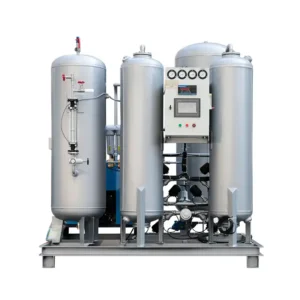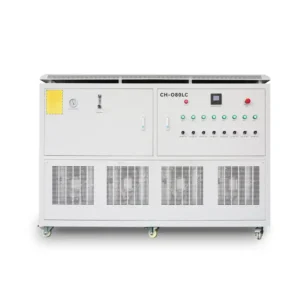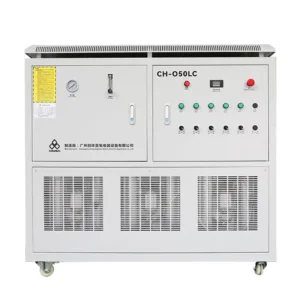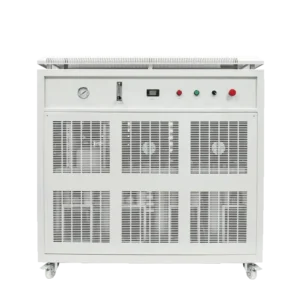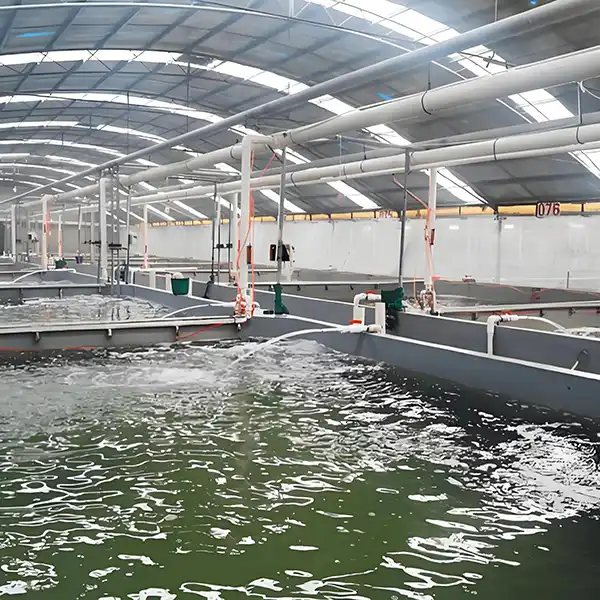
To determine the size of the oxygen generator you need, focus on your daily feed rate. For a high-density Recirculating Aquaculture System (RAS), you require 0.4 to 0.6 kg of oxygen for every 1 kg of feed distributed.
If your farm harvests 50 tons of fish annually with a peak daily feeding of 500 kg, you need approximately 250 kg of oxygen per day. Converted to flow rate, this requires a PSA (Pressure Swing Adsorption) oxygen generator capable of producing 7.5 to 10 Nm³/h (Normal Cubic Meters per Hour) at 93% purity. Always size your equipment for the “worst-case scenario”—the hottest day with the highest biomass—not the yearly average.
The Feed-Oxygen Link: Why Biomass is Misleading
Many farmers ask for a generator based solely on the total weight of fish (biomass). This is a common mistake. Fish do not consume oxygen at a static rate. A dormant fish consumes very little. A fish digesting a heavy meal consumes a massive amount.
This is called Specific Dynamic Action (SDA). After feeding, a fish’s oxygen demand can spike by 300%. If your generator is sized only for the “resting” state of the fish, your dissolved oxygen (DO) levels will crash two hours after feeding.
In a RAS environment, your limiting factor is almost always the amount of feed you can safely oxidize. If you cannot provide enough oxygen to process the protein in the feed, you cannot grow the fish. Calculate your oxygen needs based on your Maximum Daily Feed Ration.
The Math: Converting Fish Needs to Machine Specs
To choose a generator, you must convert weight (kg of oxygen) into volume (Nm³/h).
- Calculate Daily Oxygen Mass:
DailyFeed(kg)×0.5=TotalO2(kg)
(Using 0.5 as a standard safety coefficient for most species like Tilapia or Salmon). - Calculate Hourly Requirement:
TotalO2(kg)/24hours=kg/h - Convert to Volume (Nm³/h):
Oxygen has a density of approximately 1.33 kg/m³ at standard conditions.
(kg/h)/1.33=Nm3/h
Convert to Volume (Nm³/h):
Oxygen has a density of approximately 1.33 kg/m³ at standard conditions.
- Daily Feed: 150 kg.
- Oxygen needed: 150 kg feed × 0.5 = 75 kg O2 per day.
- Hourly need: 75 / 24 = 3.12 kg/h.
- Volume need: 3.12 / 1.33 = 2.35 Nm³/h.
In this scenario, a 3 Nm³/h generator is your baseline. However, you must account for transfer efficiency.
The Transfer Efficiency Gap
No system is 100% efficient. If your oxygen generator produces 10 kg of oxygen, not all 10 kg ends up inside the fish.
Oxygen Cones: 90% to 95% efficiency.
Diffuser Stones: 40% to 60% efficiency.
Venturi Injectors: 70% to 80% efficiency.
If you use diffusers, half of your oxygen bubbles to the surface and escapes into the air. You must double the size of your generator to compensate. For RAS, Oxygen Cones (Downflow Bubble Contactors) are the industry standard because they allow you to reach high supersaturation levels with minimal waste.
Species Matter: Trout vs. Tilapia
Cold-water species like Trout and Salmon are high-performance athletes. They require higher dissolved oxygen (DO) levels, usually above 7 mg/L. They have zero tolerance for fluctuations.
Warm-water species like Tilapia or Catfish are hardier. They can survive at 3 mg/L, though they won’t grow well. However, warm water holds less oxygen naturally than cold water. This is the “Solubility Paradox.” As the temperature rises, the water’s ability to hold oxygen drops, while the fish’s metabolic rate increases.
If you run a warm-water RAS at 28°C, your generator must work harder to force oxygen into the “crowded” water molecules. Always specify your operating temperature to your equipment supplier.
The Altitude Factor: A Silent Killer
PSA oxygen generators work by compressing atmospheric air and stripping away nitrogen using a molecular sieve (Zeolite).
At sea level, air is dense. At an altitude of 2,000 meters, the air is thin. There are fewer oxygen molecules for the compressor to grab. If you buy a 10 Nm³/h generator rated for sea level but install it at a high-altitude mountain farm, it might only produce 7 Nm³/h.
If your farm is not at sea level, you must “over-size” the air compressor component of your oxygen system.
Why On-Site PSA Generators Beat Liquid Oxygen
For a RAS facility, relying on delivered liquid oxygen (LOX) is a logistics nightmare.
Price Volatility: The cost of liquid oxygen is tied to fuel prices and delivery distances.
Evaporation Loss: LOX tanks “bleed” oxygen if you don’t use it fast enough. You pay for gas that vanishes into the sky.
Independence: In a storm or a supply chain disruption, a truck might not arrive. If your RAS loses oxygen, your fish start dying within 20 minutes.
A PSA generator creates oxygen from electricity and air. Your only “fuel” is the power to run the compressor. The Return on Investment (ROI) typically hits between 12 and 24 months compared to buying bottled or liquid gas.
Redundancy: The “Two is One, One is None” Rule
In high-density fish farming, the oxygen generator is the life-support machine. If the machine stops, the clock starts ticking toward a total loss of stock.
Instead of buying one giant 20 Nm³/h generator, buy two 10 Nm³/h units. Run them in parallel. If one requires a filter change or a valve repair, the other keeps the fish alive. This is not an extra expense; it is insurance.
Furthermore, always have a backup bank of compressed oxygen cylinders connected to a mechanical “normally open” solenoid valve. If the power fails and the generator stops, the valve drops open, and emergency oxygen flows into the tanks without needing electricity.
Purity: Is 99% Better Than 93%?
Industrial oxygen is often 99% pure. PSA generators for aquaculture typically produce 93% ± 3% purity.
For fish, 93% is perfect. The remaining 7% is mostly Argon and a tiny bit of Nitrogen. Neither harms the fish. Attempting to reach 99% purity requires more energy and more expensive machinery for no biological gain. Don’t pay the premium for “medical grade” purity when “aquaculture grade” is what you need.
Maintenance That Actually Matters
PSA generators are rugged but not indestructible. To keep your oxygen flow steady, focus on these three areas:
- Air Filtration: The Zeolite sieve inside the generator hates oil and moisture. If your air compressor leaks oil into the air stream, the sieve is ruined. Use high-quality oil-free compressors or multi-stage coalescing filters.
- De-humidification: Wet air destroys the molecular sieve. Ensure your refrigerated air dryer is functioning 24/7.
- Valve Timing: The “swing” in Pressure Swing Adsorption is controlled by solenoid valves. These cycle thousands of times a day. Replace them proactively every two years before they fail.
Operational Costs (OPEX)
A modern PSA system is energy efficient. On average, it takes about 1.0 to 1.2 kilowatt-hours (kWh) of electricity to produce 1 m³ of oxygen.
If you know your local electricity rate, you can forecast your monthly “oxygen bill” with near-perfect accuracy. This stability allows for much better financial planning than the fluctuating prices of gas deliveries.
Final Checklist Before You Buy
Before contacting a manufacturer, have these data points ready:
Peak Fish Weight: (e.g., 50,000 kg).
Maximum Daily Feed: (e.g., 600 kg/day).
Water Temperature: (e.g., 25°C).
Farm Altitude: (e.g., 500m above sea level).
Dissolution Method: (e.g., Oxygen Cones).
If a salesperson tries to sell you a unit without asking for your feed rate or altitude, they don’t understand aquaculture.
Proper sizing is the difference between a profitable harvest and a catastrophic pond crash. Size for the peak, build in redundancy, and prioritize air quality to protect your molecular sieve. Your fish—and your bottom line—depend on it.