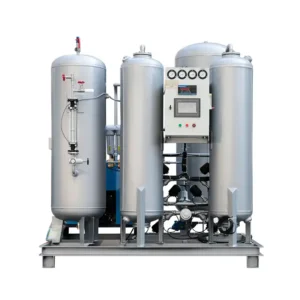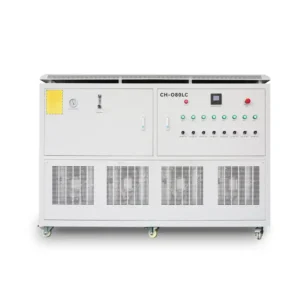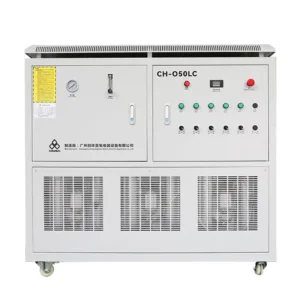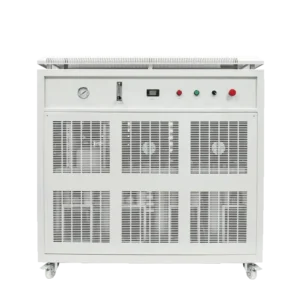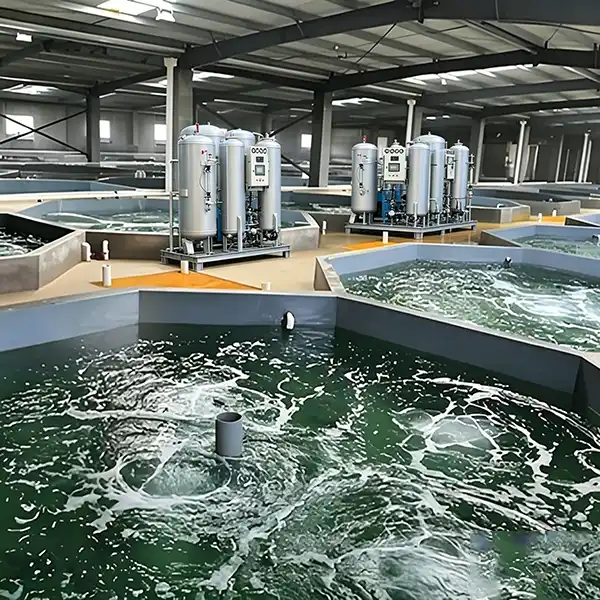
Producing oxygen onsite costs between $0.05 and $0.18 per kilogram (kg). In a standard Recirculating Aquaculture System (RAS), electricity accounts for 80% to 90% of this figure. Most industrial PSA (Pressure Swing Adsorption) generators consume between 0.6 and 1.1 kWh of electricity for every kilogram of oxygen produced.
If your local electricity rate is $0.12 per kWh, you will spend approximately $0.07 to $0.13 in power for every kilogram of oxygen injected into your tanks. When you include maintenance, filter changes, and the eventual replacement of molecular sieves, the total operating cost typically settles around $0.15 per kg.
The Oxygen Math: Defining Your Demand
In a RAS environment, you cannot estimate costs without knowing your metabolic demand. Fish do not just breathe oxygen; the system breathes with them.
For every 1 kg of feed you throw into the water, the fish require roughly 0.4 kg to 0.5 kg of oxygen to metabolize it. However, the nitrifying bacteria in your biofilter also consume oxygen. They need about 0.12 kg of oxygen for every kg of feed to process ammonia. When you factor in safe headrooms and system inefficiencies, a standard RAS farm requires roughly 0.6 kg to 1.0 kg of oxygen for every 1 kg of feed.
If your farm feeds 500 kg per day, your oxygen demand is roughly 400 kg per day. At a production cost of $0.12 per kg, your daily oxygen energy bill is roughly $48.
Electricity: The Primary Cost Driver
The air compressor is the heart of a PSA generator. It takes ambient air and forces it through a zeolite sieve at high pressure. This mechanical work is where your money goes.
Efficiency Ratios Not all generators are equal. Efficiency is measured by the “Power-to-Oxygen” ratio. High-end systems operate at 0.7 kWh/kg. Lower-end or poorly maintained systems can jump to 1.2 kWh/kg.
VFD Impact Using a Variable Frequency Drive (VFD) on your compressor can slash costs. In RAS, fish demand for oxygen fluctuates. They need more after feeding and less at night. Without a VFD, your compressor runs at 100% capacity regardless of demand, wasting energy. A VFD allows the motor to slow down, potentially saving 20% to 30% on your monthly power bill.
Maintenance and Consumables
While electricity is the dominant expense, you must budget for mechanical wear. A generator is not a static piece of equipment. It is a rotating machine.
Filtration (Annual) To protect the zeolite sieve, the incoming air must be dry and oil-free. You will replace pre-filters and dust filters every 2,000 to 4,000 hours. For a mid-sized system, expect to spend $500 to $1,500 annually on filters.
Molecular Sieves (5-8 Years) The zeolite inside the generator lasts a long time but not forever. Over years of pressure swings, the beads can break down or become contaminated by moisture. Replacing the zeolite sieve bed is a major expense. It usually costs about 15% to 25% of the original machine price. If you spread this cost over its 7-year lifespan, it adds about $0.01 to $0.02 per kg produced.
Compressor Overhauls (Periodic) Industrial compressors require a major service every 15,000 to 20,000 hours. This involves replacing valves, seals, and bearings. Depending on the unit size, this can cost between $2,000 and $8,000.
Generator vs. Liquid Oxygen: A 5-Year Financial Projection
Many farm managers hesitate at the initial price of a generator. They compare it to the “low entry cost” of liquid oxygen (LOX). This is often a mistake in RAS.
Liquid Oxygen (LOX) Costs LOX is often sold by the cubic meter or kg, but the price you see on the invoice is not the total cost. You must add:
Tank Rental: $200–$800 per month.
Delivery Fees: $50–$200 per truckload.
Evaporation Loss: A bulk tank vents gas to stay cool. If you don’t use the oxygen fast enough, you lose 0.5% to 1.5% of your inventory every day. This “boil-off” is money disappearing.
The Break-Even Point In most commercial RAS setups producing over 50 tons of fish per year, a PSA generator pays for itself in 18 to 36 months. After the “break-even” point, your oxygen costs drop by 50% to 70% compared to buying liquid gas.
Environmental Factors that Inflate Costs
Your geography changes your bill. Oxygen generators do not perform the same everywhere.
Altitude Air is thinner at higher elevations. A compressor in the mountains must work harder to pull in the same mass of oxygen as one at sea level. If your farm is at 1,500 meters, your running costs will be roughly 15% higher than a coastal farm.
Humidity and Heat Wet, hot air is harder to process. Your air dryer has to work overtime to remove moisture before the air hits the sieve. If your generator room is poorly ventilated and reaches 40°C (104°F), the system loses efficiency. You spend more electricity to produce less oxygen. Proper HVAC or simple ventilation in the generator room is a direct cost-saving measure.
Strategies to Lower Your Running Costs
If you want to keep your oxygen bill at the lower end of the $0.05–$0.18 range, use these strategies:
- Time-of-Use (TOU) Rates If your utility company charges less for electricity at night, use it. Install a larger oxygen buffer tank (a high-pressure receiver). Run your generator at full capacity during the night to fill the tank. During the day, pull from the tank and reduce the generator’s load during peak-price hours.
- Heat Recovery Air compressors generate a massive amount of heat. In cold-water RAS, you can use a heat exchanger to capture this “waste” heat and warm your culture water. This doesn’t reduce the cost of the oxygen, but it reduces your overall farm heating bill, making the oxygen essentially “subsidized” by energy recycling.
- Precision DO Monitoring Never oxygenate blindly. Every 1% of Dissolved Oxygen (DO) above your target is wasted money. Use high-quality optical DO probes linked to your generator’s control panel. If the DO hits 100% saturation, the generator should automatically throttle down.
Regional Cost Benchmarks
North America: Electricity is relatively stable. Average running cost: $0.09/kg.
Europe: High energy prices. Average running cost: $0.14/kg. Focusing on high-efficiency VSA (Vacuum Swing Adsorption) systems is more common here due to energy costs.
Southeast Asia: Low labor for maintenance, but electricity varies wildly. Average running cost: $0.07/kg in subsidized regions.
Frequently Asked Questions
Is it cheaper to run one large generator or two small ones?
Two small ones are usually better. This is called a “modular” setup. It allows you to run only one machine when fish biomass is low (like during the fingerling stage), which is much more efficient than running a large machine at 20% capacity.
Does oxygen purity affect the cost?
Yes. Producing 95% purity requires more energy than 90% purity. In most RAS applications, 90% to 93% is perfect. Trying to push for 95% or higher increases your electricity bill without providing a measurable benefit to the fish.
What is the “Cost of Failure”?
This is a financial metric most farmers ignore. If your generator fails and you have no backup, the cost is the total value of your fish. Always include the price of a small liquid oxygen backup or compressed cylinders in your budget. The “running cost” of a backup is almost zero, but its value is infinite during a crisis.
Summary of Total Ownership Costs
When planning your RAS budget, do not just look at the electricity. Use the following breakdown for a 10-year outlook:
Electricity: 85% of OPEX.
Routine Maintenance: 7% of OPEX.
Sieve Replacement (Year 7): 5% of OPEX.
Emergency Backup Fees: 3% of OPEX.
Generating oxygen onsite is the most stable way to run a fish farm. It turns a volatile variable cost (liquid oxygen prices) into a predictable utility cost (electricity). For any RAS facility aiming for a Feed Conversion Ratio (FCR) of 1.2 or better, an onsite generator is the only way to remain competitive in a high-cost market.