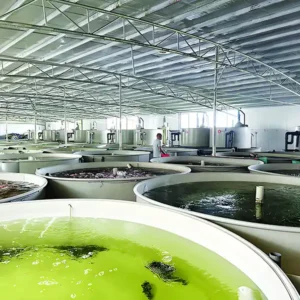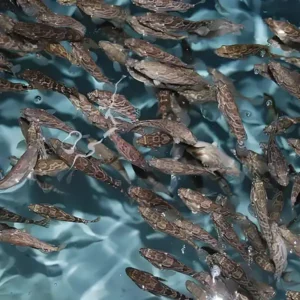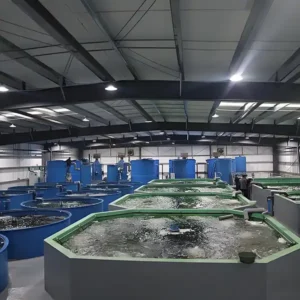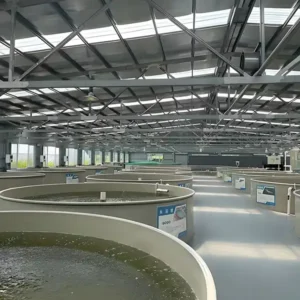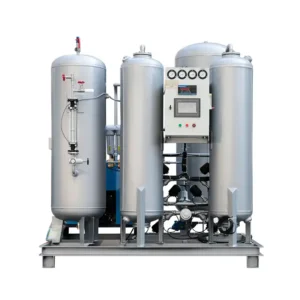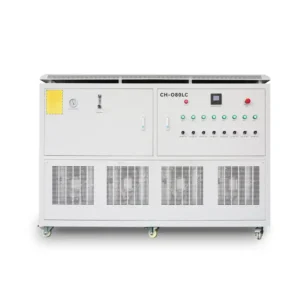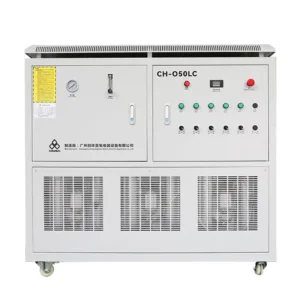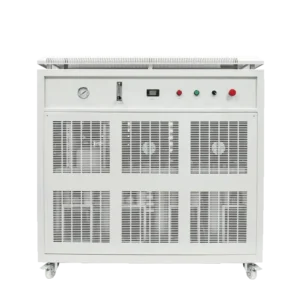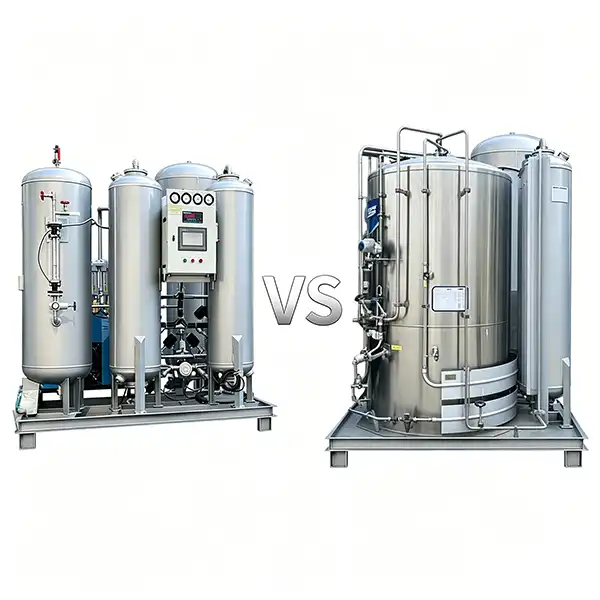
For Recirculating Aquaculture Systems (RAS), an onsite oxygen generator is better for long-term profitability and operational independence. It eliminates the logistical nightmare of liquid oxygen deliveries and provides a fixed cost for your most critical input. However, liquid oxygen (LOX) remains the gold standard for emergency backup and handling temporary biomass spikes. Most successful RAS operators do not choose one; they use a generator as their primary source and LOX as their safety net.
In high-density fish farming, oxygen is not a luxury. It is the life support system. If your dissolved oxygen (DO) levels drop for even fifteen minutes, you can lose your entire inventory. Here is how these two technologies stack up in a commercial RAS environment.
The Technology: PSA Generators vs. Bulk Liquid
Oxygen Generators (PSA/VSA Systems) Pressure Swing Adsorption (PSA) generators are onsite machines that harvest oxygen from the surrounding air. They use a material called zeolite to soak up nitrogen, leaving a stream of 90% to 95% pure oxygen. You plug it into the wall, and it breathes. It is a “set it and forget it” factory for your farm.
Liquid Oxygen (LOX) Liquid oxygen is produced offsite at massive industrial cryogenic plants. It is delivered by truck and stored in a specialized vacuum-insulated tank (a “bulk tank” or “Dewar”). To use it, the liquid passes through a vaporizer that turns it back into a gas. You are buying a finished product, not the means of production.
Operational Reliability: Power vs. Logistics
The biggest risk in RAS is a system failure. How these two sources fail is their most important distinction.
Generators: The Power Dependency An oxygen generator is a mechanical device. It has compressors, valves, and sensors. If the power goes out, the oxygen stops immediately. If a seal breaks, the oxygen stops. This means your generator is only as reliable as your backup power supply and your maintenance schedule. However, you are in total control. You don’t have to worry about a truck driver getting lost or a strike at the gas plant.
Liquid Oxygen: The Supply Chain Risk Liquid oxygen requires zero electricity to flow. As long as there is pressure in the tank and the valves are open, oxygen enters your tanks. This makes it the ultimate failsafe during a total power collapse. The weakness? You are at the mercy of a third-party supplier. If a snowstorm blocks the road to your farm, or if the price of diesel spikes, your “air” becomes incredibly expensive or unavailable.
Purity and Water Chemistry
In RAS, we aren’t just worried about the fish breathing; we are worried about gas supersaturation and nitrogen stripping.
The 93% vs. 99% Debate Liquid oxygen is typically 99.5% pure. PSA generators produce about 93% ± 3% purity. In a standard pond, this 6% difference doesn’t matter. In a high-density RAS tank where you are pushing the limits of biomass, it does.
When you inject 93% pure oxygen, the remaining 7% is mostly argon and nitrogen. If your oxygenation equipment (like a Low-Head Oxygenator or Speece Cone) is not highly efficient, that extra nitrogen can contribute to “Gas Bubble Disease.” However, modern RAS engineering has largely solved this. Most PSA systems are perfectly capable of maintaining 100% to 150% saturation without nitrogen issues, provided the system is vented correctly.
The Economic Reality: Capex vs. Opex
This is usually the deciding factor for farm managers.
The Case for Generators (High Capex, Low Opex) Buying a PSA system is expensive upfront. You have to buy the compressor, the air dryer, the tanks, and the generator itself. This can cost tens of thousands of dollars. But once it is installed, your only cost is electricity. In most regions, the cost to produce 1 kg of oxygen with a generator is significantly lower than buying 1 kg of liquid oxygen. Most RAS facilities see a return on investment (ROI) within 18 to 24 months.
The Case for Liquid Oxygen (Low Capex, High Opex) The gas company will often “rent” you the bulk tank for a nominal fee if you sign a multi-year gas contract. This keeps your initial startup costs low. However, you are paying for the oxygen, the delivery, and the “evaporation loss.” Liquid oxygen tanks constantly vent gas to prevent pressure build-up. If you aren’t using the oxygen, you are literally watching your money disappear into the atmosphere.
Scalability and Flexibility
RAS Expansion If you decide to add five more tanks to your RAS, a generator might become a bottleneck. You cannot “overclock” a generator. If your biomass exceeds the machine’s capacity, you must buy a second unit.
Liquid oxygen is much more flexible. If your fish grow faster than expected and their metabolic demand spikes, you simply turn the valve further. The bulk tank doesn’t care if you pull 10 liters or 100 liters per minute, as long as the vaporizer can handle the flow.
Location Constraints If your farm is in a remote, rural area, liquid oxygen might not even be an option. Many gas companies refuse to deliver to difficult locations, or they charge “distance surcharges” that kill your margins. For remote RAS projects, an onsite generator is the only logical choice.
The Hidden Costs of Liquid Oxygen
Many new farmers overlook the “hidden” aspects of LOX:
Pad Construction: You cannot just put a 10-ton liquid tank on the dirt. You need a reinforced, engineered concrete pad that meets local fire codes.
Permitting: Storing large amounts of liquid oxygen often requires specialized permits from local fire departments or environmental agencies.
Evaporation: A standard LOX tank loses about 0.5% to 1% of its volume every single day due to “boil-off.” Over a year, this is a massive amount of wasted inventory.
Maintenance Requirements
PSA Generators: These are industrial machines. You have to change the oil in the compressor. You have to replace air filters. Every few years, you may need to replace the zeolite molecular sieve. If you have a technician on staff, this is easy. If you don’t, a breakdown can be catastrophic.
Liquid Oxygen: The maintenance is almost zero. The gas company owns the tank and usually handles the inspections. Your only job is to check the pressure gauges and ensure the vaporizers don’t ice up during high-flow periods.
The “Golden Standard” Setup for RAS
If you want to reach the top 3% of RAS efficiency, you don’t choose between them. You integrate them.
The Primary Source: PSA Generator You size your generator to handle 100% of your average daily oxygen demand. This keeps your “cost per kg of fish produced” at its absolute minimum.
The Secondary Source: Liquid Oxygen Backup You keep a smaller liquid oxygen tank on standby. It is connected to your main oxygen line via an automatic changeover valve (a “Solenoid Bypass”).
How it works in practice:
The generator runs 24/7, providing cheap oxygen.
If the power fails, the solenoid valve drops open.
The liquid oxygen tank immediately takes over the load without any human intervention.
If you have a “harvest week” where fish density is at its peak and the generator can’t keep up, the LOX system kicks in to provide the “top-off” oxygen.
Why RAS Operators are Moving Away from LOX
In the last five years, there has been a massive shift toward onsite generation. There are three reasons:
Price Volatility: The cost of liquid oxygen is tied to the cost of electricity and trucking. As energy prices fluctuate, LOX prices become unpredictable.
Carbon Footprint: Trucking tons of liquid oxygen across the country is not “green.” Large retailers buying RAS-grown fish are starting to look at the carbon footprint of the farm’s supply chain.
Independence: RAS is about control. You control the temperature, the pH, and the waste. Relying on a gas company is the one part of the system you can’t control.
Summary Table for RAS Decision Making
| Feature | PSA Oxygen Generator | Liquid Oxygen (LOX) |
|---|---|---|
| Long-term Cost | Lowest (Electricity only) | Highest (Gas + Delivery) |
| Initial Investment | High (Equipment purchase) | Low (Tank rental) |
| Independence | Total (Onsite production) | Low (Supplier dependent) |
| Reliability | Mechanical (Needs backup power) | Physical (No power needed) |
| Purity | 93% – 95% | 99.5% |
| Scalability | Fixed capacity | High flexibility |
| Best For | Daily base load | Emergency backup/Peak load |
Final Verdict
Is an oxygen generator better than liquid oxygen? Yes, for your daily operations. It protects your margins and gives you total control over your life-support system.
However, liquid oxygen is better for your peace of mind. No professional RAS facility should operate without a backup. If you are building a new farm, budget for a high-quality PSA generator as your workhorse, but keep a liquid tank as your insurance policy. The cost of the LOX backup is nothing compared to the cost of losing 100 tons of market-ready fish.